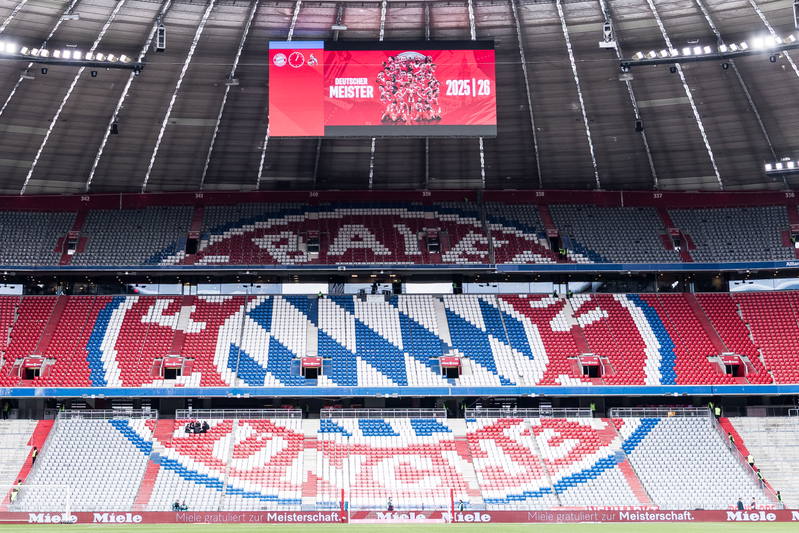
Germany sold 21,404,258 tickets across professional football in 2025/26, the highest total the country has recorded. The main engine was the Bundesliga, which accounted for 12,718,097 of those sales, up 9.1 percent from 11,653,239 in 2024/25. A league average of 41,562 per match and four clubs at 100 percent occupancy show this was not just a healthy season. It was a genuine jump.
bundesliga.com summed it up plainly: "A total of 21,404,258 tickets were sold in Germany last term, marking another new ticket sales record for professional football in the country."
The Bundesliga drove the record
The headline number is the national record, but the sharper point sits underneath it. The Bundesliga was responsible for most of the momentum.
Its 12,718,097 tickets sold is the standout figure because it came with a significant year-on-year rise, not a flat hold at an already high level. The increase from 11,653,239 to 12,718,097 means the league added more than a million ticket sales in a single season. For a competition that already operates from a very high attendance base, that is serious growth.
The average attendance tells the same story. Bundesliga grounds averaged 41,562 spectators per match in 2025/26, up from 38,082 in 2024/25. That kind of jump across a full season is more convincing than a one-off big gate or a handful of marquee fixtures. It points to demand holding across the calendar.
This is where the league still separates itself. Plenty of top divisions can produce a few huge occasions. The Bundesliga's strength is that strong matchday demand is built into the weekly schedule, and the 2025/26 numbers reflect that again.
Full stadiums and the clubs behind them
The occupancy figures add another layer. Union Berlin, Bayer Leverkusen, Bayern Munich and St. Pauli all reached 100 percent stadium occupancy.
bundesliga.com put it directly: "Union Berlin, Bayer Leverkusen, Bayern Munich and St. Pauli all achieved maximum stadium occupancy of 100 percent."
That spread matters more than it would if the list contained only the most obvious commercial heavyweights. Bayern's presence is no surprise, but Union Berlin and St. Pauli being part of the same group helps explain why the overall rise feels broad rather than concentrated. The record was supported by clubs with different capacities and different fan bases, which makes the attendance picture look healthier than a simple big-club boom.
There is a useful distinction here between occupancy and raw attendance. A full stadium does not always mean the biggest crowd in absolute terms, but it does show demand meeting available supply. Four clubs hitting that ceiling in the same season is a strong sign of a league with very little slack in several markets.
The second tier adds a bit more depth to the picture as well. Preußen Münster led occupancy in Bundesliga 2 with almost 100 percent, while Schalke followed with just under 99 percent. Even without folding those clubs into the top-flight story, it reinforces the idea that matchgoing demand in German football remains very strong beyond one division.
Dortmund and Bayern still set the pace for crowd size
While the broader record was league-led, the biggest live draws in absolute terms were still familiar names. Borussia Dortmund averaged almost 80,000 spectators per home match, ahead of Bayern on roughly 75,000. Hamburg were next on around 56,900.
Those numbers do not prove the record was carried by one club, and they should not be stretched that far. What they do show is that the traditional attendance giants still give the Bundesliga a huge platform in raw crowd volume, while the rest of the league is keeping pace strongly enough to push the national total to a new high.
That is probably the most convincing part of the 2025/26 picture. The Bundesliga did not need a single-club explanation. It had giant weekly crowds at the top end, a league average of 41,562, and four clubs selling every seat available.
For all the debate around modern football's commercial model, Germany's matchgoing numbers remain one of its strongest arguments. The record now stands at 21,404,258 tickets sold, with the Bundesliga responsible for 12,718,097 of them.
FAQ
Why did the Bundesliga attendance record grow so sharply in 2025/26?
The clearest reason is scale. The Bundesliga sold 12,718,097 tickets in 2025/26, up 9.1 percent from 11,653,239 the previous season. Its average attendance also jumped to 41,562 from 38,082, so the top flight supplied most of the growth behind Germany's overall record of 21,404,258 tickets sold.
Which Bundesliga clubs had 100 percent stadium occupancy in 2025/26?
Union Berlin, Bayer Leverkusen, Bayern Munich and St. Pauli all reached 100 percent stadium occupancy. That detail matters because the attendance surge was not limited to one traditional giant. Full houses were spread across clubs with very different profiles and stadium sizes.
Did Borussia Dortmund or Bayern Munich have the biggest crowds in Germany?
Borussia Dortmund led the Bundesliga in raw average attendance with almost 80,000 spectators per home match. Bayern Munich followed on roughly 75,000. Those two still set the pace for absolute crowd size, even though the wider record depended on league-wide growth rather than one club alone.
How many tickets were sold in German professional football in 2025/26?
German professional football sold 21,404,258 tickets in 2025/26, a new national record. The Bundesliga was the main driver of that total, contributing 12,718,097 ticket sales and an average attendance of 41,562 per match.
Written by Jack Mercer with AI-assisted research, cross-checked against 1 outlet. How we work →